
Tonight is like the World Cup or Super Bowl in finance and tech: NVIDIA ( NVDA ), the largest market cap company in the world, is reporting its quarterly earnings. The company has become a household name since its phenomenal rise.
Where Did NVIDIA Come From?
Three electrical engineers founded NVIDIA in 1993: current CEO Jensen Huang, current Senior VP for Engineering and Operations Chris Malachowsky, and Curtis Priem, who left the company in 2003. The trio reportedly met in a Denny’s in San Jose, CA and formed the company together.
NVIDIA “invented” the GPU in 1999. Created as a graphics card for consumer use, the product was the GeForce 256. I say “invented” because graphics processing has a storied history for a few decades before the GeForce 256.
History of the GPU
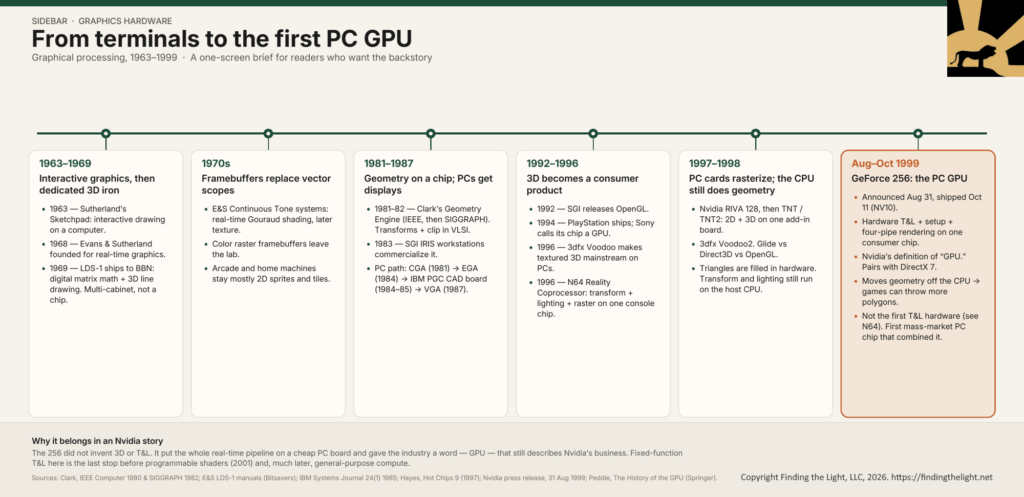
Dedicated graphical processing dated back all the way to 1963, where Ivan Sutherland created the first CAD ( computer-aided design ) program called Sketchpad, or “Robot Draftsman,” for his PhD thesis. Ivan would go on to create Evans & Sutherland with Professor David Evans.
1960s – The Beginning
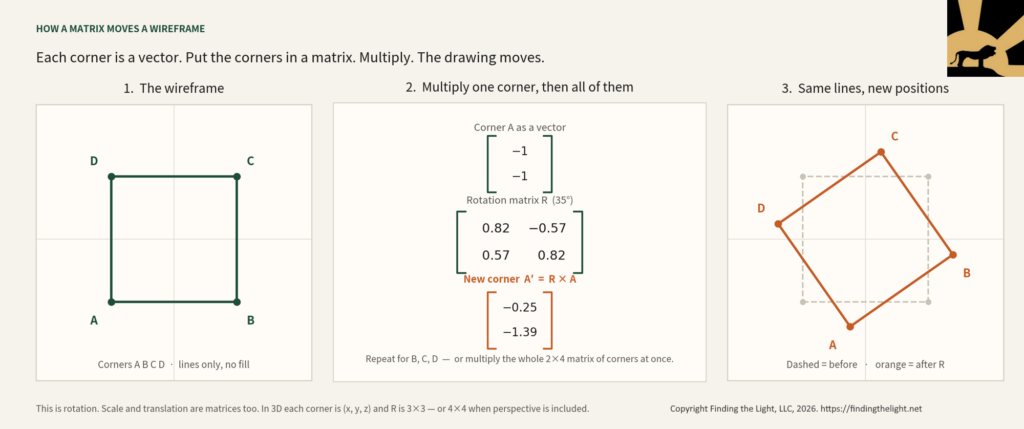
In the 1960s, a picture was composed of lines, or vectors. Vector graphics stored geometry, endpoints and connections, and steered an electron beam to draw wireframes to a screen sixty times a second. In the late 1960s, Evans & Sutherland began to use matrices ( grids of values ) and matrix math to move wireframes. At this point, graphics were moving just points and lines, but the concept of matrix calculations for graphical processing would go on to define graphics processing and modern compute as it is today.

1970s – The Picture Becomes a Grid in Memory
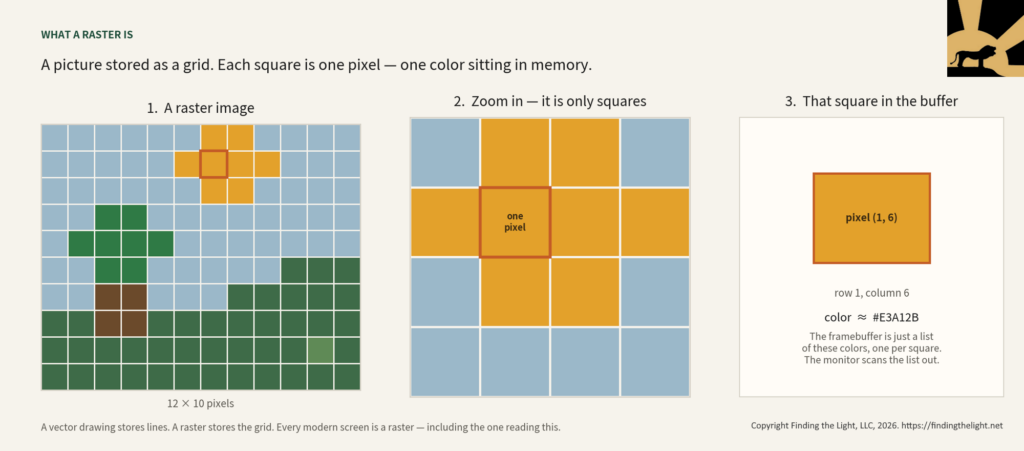
In the 1970s, Evans & Sutherland began to use raster graphics, which used a frame consisting of a grid of colored dots ( pixels ) that lived in memory as a framebuffer. This would become the standard for modern screen graphics, e.g.: TVs, monitors, phones, etc.
1980s – Matrices Get Their Own Chip, Framebuffer Quickly Evolves
In the early 1980s, Jim Clark creates the Geometry Engine, which is a chip whose only job was to perform vector and matrix calculations, including transforms, clipping, and mapping to the screen. Raster work was still done separately. In 1983, Silicon Graphics ( SGI ) created IRIS, a workstation that productized this geometry chip. This gave a pipeline to the graphical process in a workstation: geometry board, then raster boards, then a framebuffer.
Also, through the 1980s, framebuffers themselves evolved, though they remained 2D buffers instead of 3D:
- 1981 — CGA: a small color framebuffer
- 1984 — EGA: a better one
- 1984–1985 — IBM Professional Graphics Controller: onboard processor, 640×480, 256 colors, aimed at CAD
- 1987 — VGA: Video Graphics Array, the framebuffer layout the PC world standardizes on
Ever hear of a VGA cable, the older cable with the blue 15-pin connector for a monitor? Yep. Now we’re getting more modern.
1990s – Pixels in Consoles and PC Evolution
In 1992, OpenGL publishes the pipeline as a standard: transform vertices, light them, rasterize triangles, then write a framebuffer. In 1994, Sony ships the PlayStation with a chip that tech reports refer to as a custom CPU.
By 1996, 3dfx Voodoo makes the raster half real for games with a Windows PC add-on card. It takes triangles and paints textured pixels into a buffer fast enough to play GLQuake. The CPU still performed matrix calculations, vertex by vertex. Meanwhile, the Nintendo 64’s Reality Coprocessor by SGI packages the pipeline of transform, lighting, and raster together in one chip three years before a Windows PC can.
In the late 90s, NVIDIA’s RIVA 128 cards and 3dfx Voodoo cards increased the pixel fill rate, while adding multitexture and 32-bit color. PC graphics cards handled triangles, pixels, then the framebuffer, yet the CPU calculated vectors, matrices, and lighting.
1999 – NVIDIA’s GeForce 256
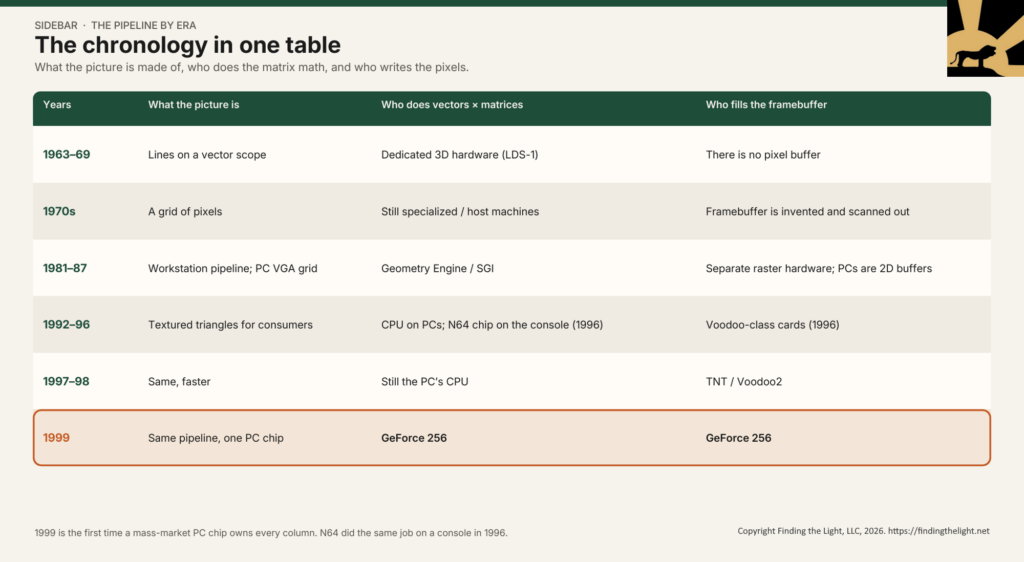
On October 11, 1999, NVIDIA ships its GeForce 256. On this card, for the first time in a mass-market PC the pipeline shifts to a single card:
- Game code provided vectors
- The chip calculated matrices and lighting ( hardware T&L )
- The same chip set up and rasterized triangles
- A framebuffer and depth buffer sit in the chip’s own memory
NVIDIA’s GeForce 256 was the first cheap PC hardware to put everything together. Further, they marketed the product as a “GPU.”
NVIDIA’s Graphics Revolution
While NVIDIA didn’t literally invent graphics processing or even the name “GPU,” they arguably first commercialized both the product for PC and the term as we understand them today: a single, consumer-affordable piece of hardware capable of separately performing the entire graphical processing pipeline. If we want to be technical, perhaps we should say: “NVIDIA invented the non-integrated consumer PC GPU.”
This marks a pivotal point in technology: Once graphical processing gained its own separate hardware for consumer PCs, it opened up possibilities for consumer software, which drove a cycle of hardware that could support better software, and a positive feedback loop of demand for better software driving demand for better hardware. With Internet connectivity ramping up at the consumer level, generations of people would see their lives drastically change.
Dedicated graphics processing made whole classes of new work available because they wouldn’t bottleneck at the system’s CPU or memory, and because they were affordable and would diffuse throughout the technology ecosystem.
Just the Beginning
While we’ve uncovered much of the surface-level events that led to NVIDIA’s first revolutionary GPU, there is so much more we could talk about from this point in the story to the present. This article is getting long, so I think the above chronology suffices for the context. I might cover the remaining history in another article.
Suffice it to say that NVIDIA created something special, and continued to innovate in ways that would change the world. From simple wireframe rendering, all the way to real-time photorealistic cinematics and gameplay, and radical steps in machine-learning, NVIDIA’s work is undeniably impressive and valuable.
What Does NVIDIA Do Today?
Today’s NVIDIA has changed dramatically from its consumer GPU roots. While the company still makes some of the best consumer GPUs money can buy, NVIDIA’s revenue streams have vastly changed.
Revenue Streams
GAAP ( Generally Accepted Accounting Principles ) are a mandatory, standardized set of rules used by public companies in the US for financial reporting. In GAAP-reportable segments, NVIDIA reports revenue in two operating segments:
- Compute and Networking – revenue from their data center compute, networking, and automotive operations
- Graphics – revenue from their consumer / gaming PC and RTX / Quadro workstations
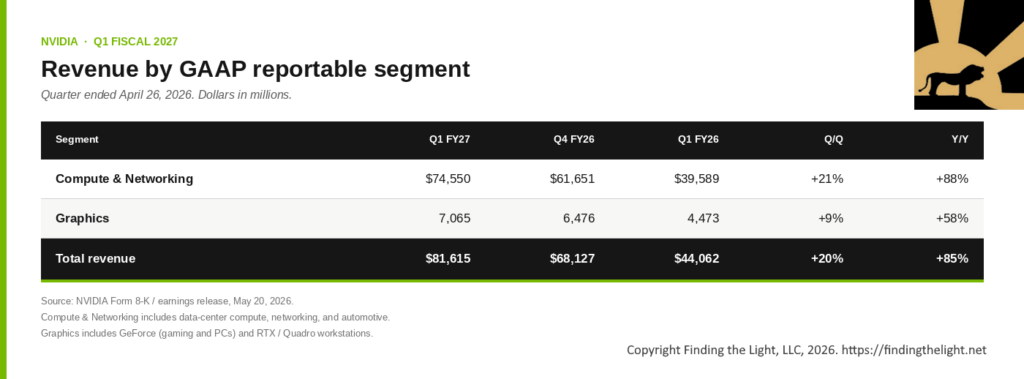
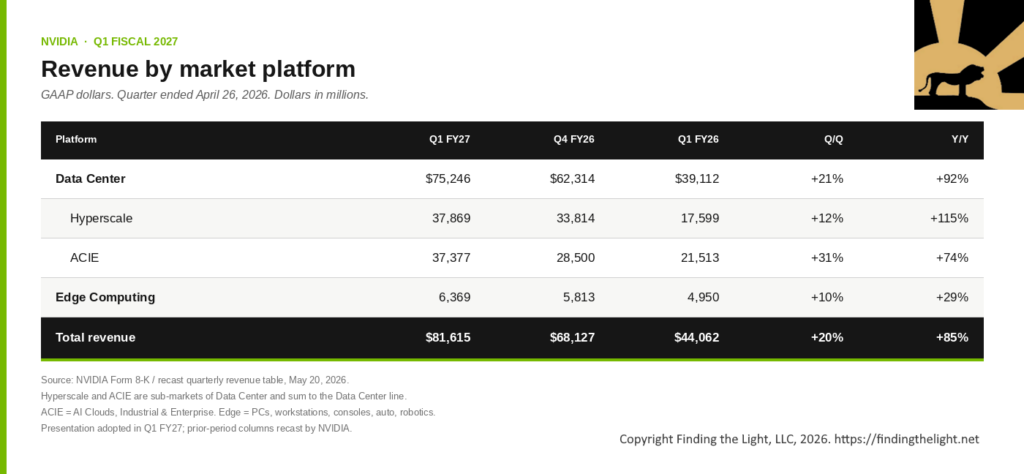
NVIDIA prefers to report a breakout of these segments by market platform:
- Data Center
- Hyperscale
- ACIE
The Graphics segment, which is relatively small, is rolled into these three operating segments. What this clearly shows is that NVIDIA is no longer the consumer GPU company it once was. The company still makes billions of dollars in revenue from GPU sales, but relative to their overall revenue, consumer GPUs made up 10.15% in Q1 2026, 9.5% in Q4 2026, and 8.65% in Q1 2027.
Major Products and Services
Blackwell
NVIDIA’s Blackwell GB200 and Blackwell Ultra GB300 NVL72 are the current premium racks being sold for datacenters. They include 72 GPUs and 36 NVIDIA Grace CPUs in one rack, which sports a whopping 130 TB/s of total bandwidth. The GB300 rack is estimated to have up to 1.5x more performance.
Vera Rubin
The Vera Rubin NVL72 rack includes 72 Rubin GPUs and 36 Vera CPUs. NVIDIA claims that Vera Rubin NVL72 racks can deliver:
- 10x lower inference token cost and 4x fewer GPUs to train MoE ( Mixture-of-Experts ) models compared to GB200 NVL72.
- 30x higher throughput per megawatt and 35x less token costs than its Blackwell Ultra GB300 NVL72 using DeepSeek VC4-Pro-class agent workloads.
Additionally, using HMB4 ( high-bandwidth memory ) and NVLink 6, the rack’s total bandwidth is 260 TB/s, double that of Blackwell.
Software and Infrastructure
NVIDIA’s Blackwell and Vera Rubin are hardware racks ( rather than single cards ) that make tons of compute for training and running machine learning ( “AI” ) models. What enables these, and a major factor preventing companies from switching out NVIDIA chips for something else at some point, is NVIDIA’s software and infrastructure.
Cuda
Every serious model is written against this programming model, compiler, libraries, and 15-plus years of kernels. CUDA enables the expert parallelism, quantization, and tuned communication across a 72-GPU NVLink domain. Unless you want to deal with the compiler, collectives, and profiler yourself, you need CUDA.
NIM
NVIDIA Inference Microservices are prebuilt, versioned containers for service stacks and workloads. These are updated by ongoing CUDA workloads, so ongoing use reinforces their capability across the ecosystem. In essence, NIM acts as distribution for an API, and customers only need exposure to its URL on the platform they use, instead of having to deal with drivers themselves.
Dynamo
NVIDIA’s open-source, multi-node inference framework. It acts as the rack operating system, orchestrating tokens across the 72 GPU rack when a model has a prompt sent to it. Dynamo also handles caching and fast recovery for loading model weights.
Spectrum-X Ethernet
While NVLink moves data up and down the rack, Spectrum-X moves it through the datacenter. Spectrum-X rebuilt Ethernet for the opposite pattern that ethernet was built for. The AI factory pattern consists of a few enormous, synchronized flows. Regular Ethernet was designed for many small, independent flows. It uses Spectrum switches, ConnectX SuperNICs, and adaptive routing.
NVLink Fusion
This may be one of the most important parts of the NVIDIA ecosystem package for the next few years. NVLink Fusion allows integrating a customer’s desired custom chip into the stack, if that is what they desire. This allows for AWS’s Trainium, Google’s TPU, and Microsoft’s Maia onto NVLink 6, into the same 72-device domain as Rubin, Vera, and the rest of the software and infrastructure stack.
Price History
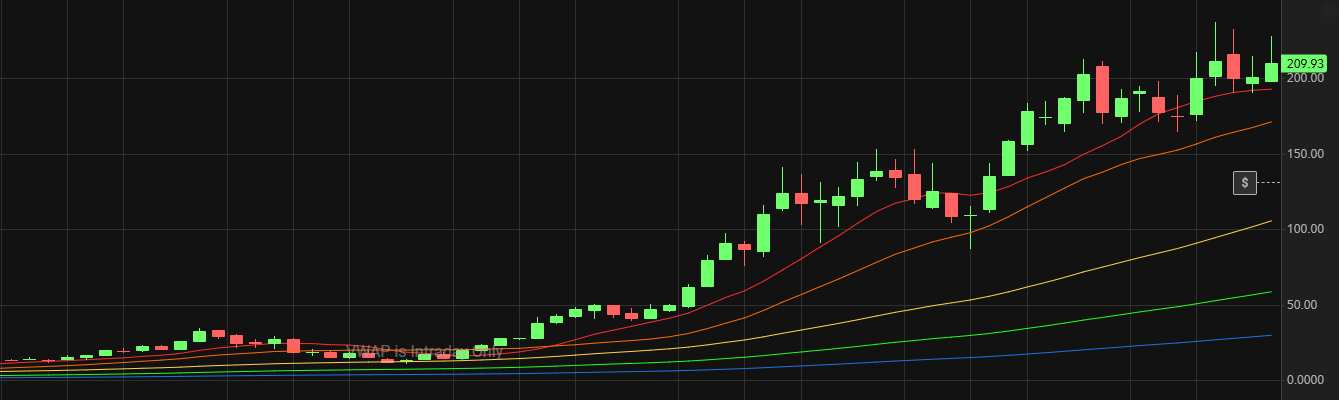
In September of 2018, NVIDIA reached a high of just $7.14, and by May of 2019, it was closing at $3.39. By August of 2020, however, the stock closed at $13.37, and by November of 2021, closed at a record $32.68.
That 2021 print was the top of the first GPU cycle that Wall Street fully believed in — gaming, data center, and a crypto hangover still mixed together. NVIDIA split 4-for-1 in July 2021 on the way up. All prices here, including those 2018–2021 figures, are adjusted for that split and for the later 10-for-1, so they match the share count investors hold today.
Then the stock was cut in half. 2022 opened near $30. The gaming pull-forward from the pandemic reversed, crypto mining demand vanished, and China export rules started to bite. On a split-adjusted basis, the shares bottomed around $11.20 in October 2022 and closed the year at $14.58 — a 50% calendar-year decline, and a two-thirds drawdown from the November 2021 high.
Models Become Mainstream
ChatGPT shipped six weeks after that low. In 2023, the market decided NVIDIA was no longer a graphics company. The stock opened the year at $14.28, closed it at $49.43, and never seriously looked back. That is a 239% year — the first full year of the Hopper data-center run.
2024 was the year the multiple and the revenue caught up to each other. Shares opened at $48.08. On June 10, NVIDIA split 10-for-1, taking a four-digit pre-split quote back into three digits so the stock could keep trading like a liquid index name. It closed 2024 at $134.09, up 171%, with an intra-year high of $148.65.
The stock had to contend with a new, default question in 2025: “Is this a bubble?” NVDA opened at $138.10, sold off to $94.18, then ran to $206.78 and closed the year at $186.20. It was still a 39% gain, but no longer a straight line. The mid-year dip was attributed to DeepSeek, China, and duration-of-the-capex-cycle scares.
Year-to-Date
2026 opened at $188.62. The split-adjusted all-time closing high so far is $235.47 on May 14, 2026 (intraday high $236.54). As of Tuesday’s close, the stock was $213.05; it is trading around $210 into tonight’s report. Year-to-date, that is still a gain, but the range from $165 to $236 is the market arguing, every other week, whether the AI factory build is mid-cycle or late-cycle.
From the May 2019 close of $3.39 to this week’s $210 is roughly a 62-fold move in seven years. From the October 2022 low of $11.20 it is about a 19-fold move in less than four. The 2018 high that looked like a peak, $7.14, is now a rounding error on a single day’s range.
Leave a Reply